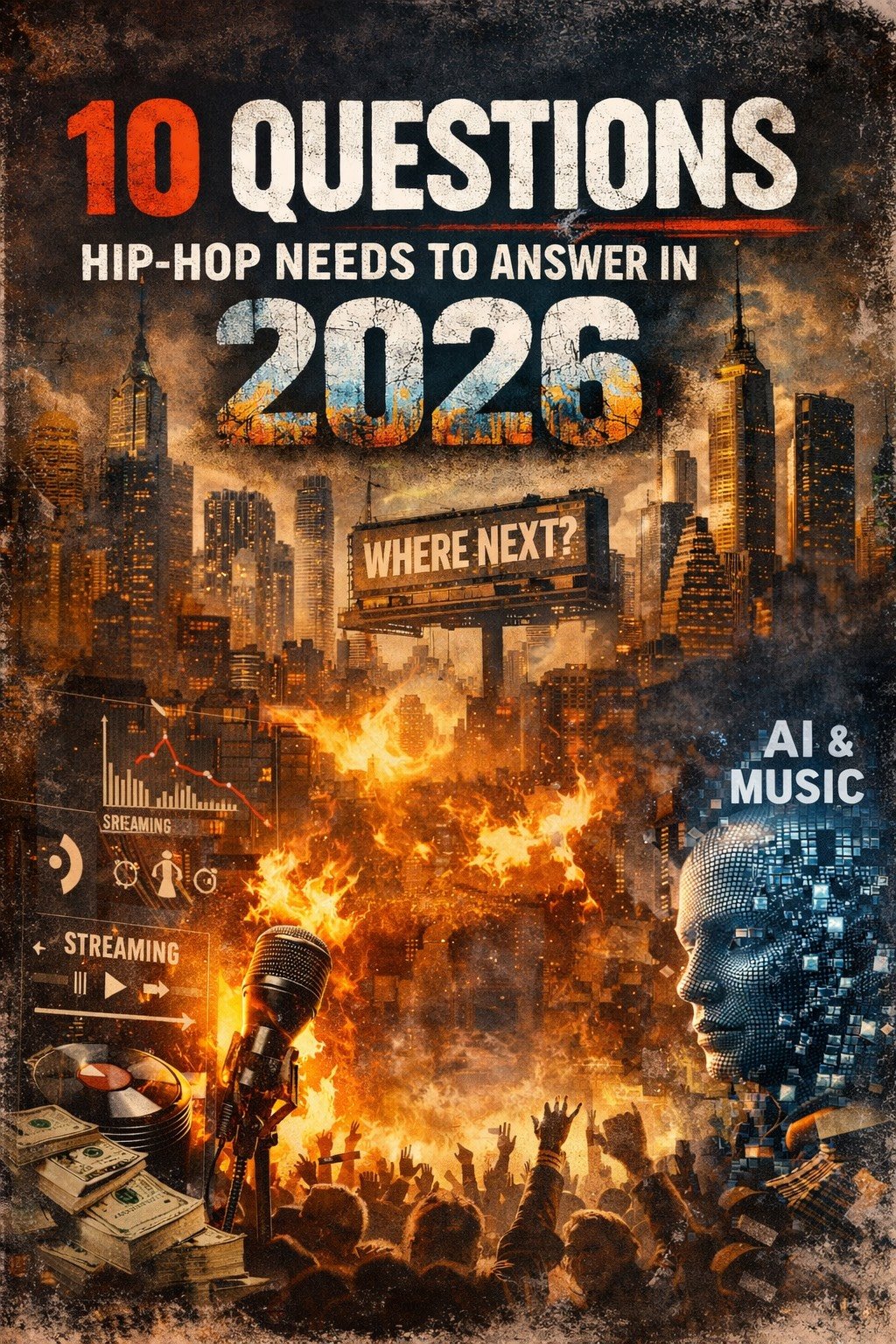
10 Questions Hip-Hop Needs to Answer in 2026
Written by Malik Perkins
January 1, 2026
Source: Raymond Alva
Hip-hop entered 2025 with momentum and exited it with uncertainty. While the genre remained commercially powerful, the year exposed cracks that can no longer be ignored—chart instability, generational bottlenecks, and a widening gap between moments and meaning. As 2026 approaches, these ten questions will shape whether hip-hop evolves with intention or continues to coast on familiarity.
10. What does success even look like now?
In 2025, hip-hop continued to generate massive streaming numbers, but success felt thinner than it once did. Albums debuted high and disappeared quickly. Singles went viral without translating into sustained careers. Visibility increased while impact quietly eroded.
For years, success meant domination—streams, sales, chart placement. But by the end of 2025, it became clear that chasing numbers alone often led to burnout rather than longevity. As 2026 approaches, hip-hop must decide whether success is still defined by peaks, or whether sustainability, creative freedom, and cultural resonance matter more than perpetual chart presence.
9. Is hip-hop still rebellious—or just comfortable?
Hip-hop was built as a disruptive force, but much of 2025 felt unusually safe. Brand partnerships were ubiquitous, controversy was carefully managed, and even conflict was filtered through public relations logic.
That doesn’t mean artists lacked edge—but the risks felt calculated. Rebellion increasingly existed as an aesthetic rather than a challenge to systems, power, or audiences. The question for 2026 is whether hip-hop can still unsettle culture in meaningful ways, or whether comfort has replaced confrontation as the genre’s default mode.
8. Can albums feel meaningful again?
Albums didn’t disappear in 2025, but many felt bloated—long tracklists designed to maximize streams rather than communicate intent. Too often, projects functioned as content reservoirs instead of cohesive statements.
Listeners can tell when an album is authored versus assembled. In 2026, the artists who stand out may be the ones willing to release less material with sharper focus—projects with narrative, restraint, and purpose.
7. Are regional sounds returning—or are we fully flattened?
Regional identity once defined hip-hop. In 2025, much of mainstream rap sounded geographically unmoored, shaped more by algorithms than by place.
Still, beneath the surface, regional energy persisted—artists emphasizing accent, cadence, and community storytelling. The question for 2026 is whether those sounds will be allowed to scale without being diluted.
6. What does authenticity mean in an AI-assisted era?
By 2025, AI in music was no longer hypothetical. While mainstream hip-hop largely avoided overt AI usage, its presence forced uncomfortable conversations about authorship and voice.
Hip-hop has always been rooted in lived experience. In 2026, the genre must confront whether authenticity is defined by process, intention, or emotional truth.
5. What role do women play in shaping the next era?
Women were among the most influential forces in hip-hop throughout 2025, driving sound, fashion, and conversation. Yet their success is still often framed as episodic.
The question for 2026 is whether women are recognized as architects of the genre’s future, not just chart leaders or viral personalities.
4. Can lyricism thrive without being framed as nostalgia?
Lyricism resurfaced in 2025 often framed as a return to the past. That framing limits its future.
The challenge for 2026 is whether lyrical depth can exist naturally in modern hip-hop without apology or retro framing.
3. Is hip-hop building stars—or just feeding viral moments?
During multiple stretches of 2025, hip-hop struggled to anchor the charts, with pop and country filling space once dominated by rap.
Viral singles exploded, but few artists translated moments into sustained presence. If 2026 doesn’t restore the ability to build artists with arcs, hip-hop risks becoming disposable.
2. Will a new or younger artist truly break through?
Outside a handful of names, 2025 was held together by veterans and proven hitmakers.
If 2026 fails to produce at least one undeniable new star, the genre risks creative stagnation.
1. What is Drake’s next move after the Kendrick Lamar beef?
The clash between Drake and Kendrick Lamar forced listeners to confront what they value most in hip-hop.
Drake’s next move will redefine how megastars age in the genre—and whether dominance alone is still enough.
If 2025 was about endurance, 2026 will be about direction. Hip-hop doesn’t need saving—but it does need clarity about who it’s building, what it values, and where it’s willing to go next.